Importance of Note-taking
Note-taking is a crucial skill for any student, especially for learners of English. By actively engaging with the material being studied or presented, taking notes can help students stay focused. Note-taking can assist in:
- Recalling important information
- Organizing thoughts
- Improving listening and comprehension skills.
Additionally, as you review your notes, your understanding of the language is reinforced. Combined with the act of writing, the entire process helps you to improve your vocabulary and grammar skills
Note-taking Strategies
When it comes to note-taking, there are numerous strategies to choose from. As an ESL/EFL learner, it’s important to find a method that works best for you. Although there are lots more, we’ve selected five note-taking strategies that may be particularly helpful for improving your English skills. These are the Cornell method, Mind Mapping, Outlining, Apps and a Combination approach.
Cornell Note-Taking Method (Paper-Based)
How it Works
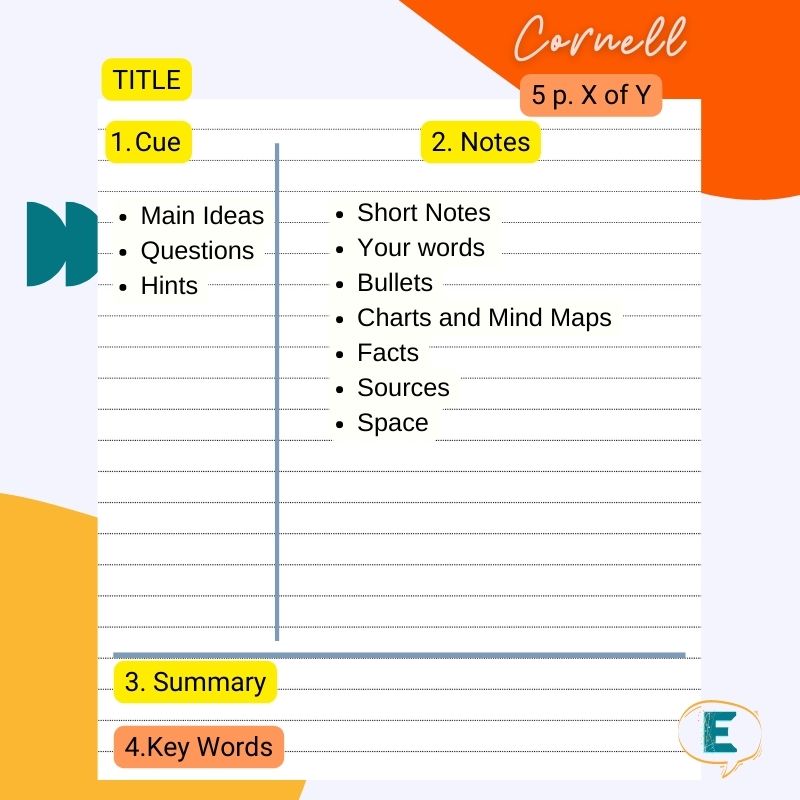
The Cornell method is a classic note-taking strategy that involves dividing the paper into three sections. The largest section is for notes with smaller sections for cues and questions. At the bottom is a summary section. The cues and summary sections help you reflect on the material, while the main section allows you to take detailed notes. This method is useful for lectures, presentations, and reading assignments.
Modifications
As with any method, you should modify to suit your way of working. In the above image, the typical Cornell layout (1 – 3) is split into three sections with the title—or subtitle—at the top. With my students, I suggest making two additions (4 and 5). I like to split the summary into two sections so at the bottom you can write down keywords. (4) These can help to organize ideas and revise. Another recommendation, is to leave space at the top (5) to write a page number. However, wait until you have compiled all your notes for a topic before introducing a numbering system.
Pros
Helps you:
- Organize information
- Improve recall and retention
- Think critically
- Study for tests and exams
Cons
- Takes time and effort to create
- May not suit situations when you have to take notes quickly
Example
The Cornell method is great when you are revising for exams and compiling notes from lots of sources. You also have blanks sections for summaries—excellent for revision—and for questions.
By writing down your questions and observations, you have a clear idea about what else you need to clarify or find out.
Mind Mapping (Paper-Based or Digital)
How it Works
Have you used mind mapping? It is a method often used with brainstorming but can be equally useful for note-taking that involves a single subject with many components.
With mind mapping, you can take a non-linear approach to note-taking. This means that you can explore your ideas in a more creative way. Unlike the traditional way of writing notes, where you take them in a linear fashion, mind mapping allows you to visualize your ideas and connect them in a more natural way.
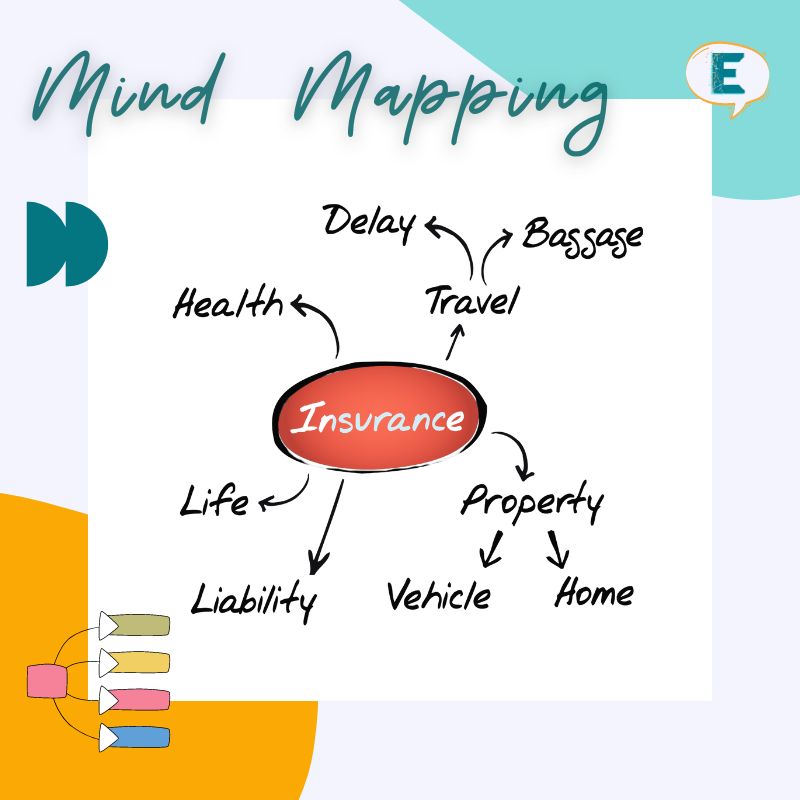
When you use mind mapping, you start with a central idea and then radiate outwards. Sub-ideas are connected to the central idea with lines. The lines represent the relationships between the ideas. To help you memorise, you can add colour, symbols and images.
This technique helps you to see the big picture and find patterns that you might not have noticed before.
As well as organizing notes for difficult topics, mind mapping is useful for out-lining essays or reports.
It’s a great way to get creative with your note-taking and explore your ideas in a new way!
Pros
They help you:
- Stimulate creativity and imagination
- Improves comprehension and analysis
- Encourages active learning
Cons
- May not work well for linear or factual information
- Requires some skill and practice to create effective maps.
Example
Imagine you have to write about “The Benefits of Exercise.” Using a mind map, you can start by placing “The Benefits of Exercise” in the centre of the page. Then, you can brainstorm different sub-ideas related to this topic, such as “Physical benefits,” “Mental benefits” and “Social benefits”.
Each sub-idea can then be further divided into smaller ideas. For instance, under “Physical benefits,” you can include sub-ideas such as “Weight loss,” “Improved heart health” or “Stronger bones”. etc. By using a mind map to organize and review your notes, you can record connections that will help you produce more coherent and comprehensive writing.
Alternative Method - Post-It Notes
Another way to create a visual representation of your notes is by using post-it notes. This is a tactile and versatile method that can be helpful for those who prefer physical note-taking or need to move their ideas around.
To use post-it notes for note-taking, simply write down a main idea or concept on a large note and then use smaller notes of different colours to add sub-ideas as discussed in the previous section.
Outlining (Paper-Based or Digital)
How it Works
The Outlining Method offers a systematic and effective way to organize and structure your notes. By creating an outline, you can easily identify the main points and sub-points of a lecture or text, and see how they relate to each other. This makes it easier to remember and understand the information, as well as to review and study later on. Moreover, outlining can help you to identify any gaps or inconsistencies in your knowledge, and to fill them in with additional research or clarification.
When outlining, it’s important to use a consistent format, such as Roman numerals for main ideas, capital letters for sub-ideas, and bullet points for details. This helps to maintain clarity and consistency throughout the outline. It’s also a good idea to include brief notes or summaries for each point, to remind you of the key information and examples.
While outlining can be done with pen and paper, electronic tools such as Microsoft Word or Google Docs offer several advantages. These tools allow you to easily reorganize and rearrange the outline as needed, and to add or delete points without having to rewrite the entire outline. Additionally, electronic outlining allows for easier collaboration and sharing of notes with others.
Overall, the Outlining Method is a valuable tool for note-taking, research, and studying. It can help you to organize and structure your notes in a logical and effective manner, and to understand and remember the information better.
Pros
They help you:
- Improve organization
- Identify areas where you are weak
- Highlight unecessary information
Cons
- May not work well for linear or factual information
- Requires some skill and practice to create effective maps.
Example
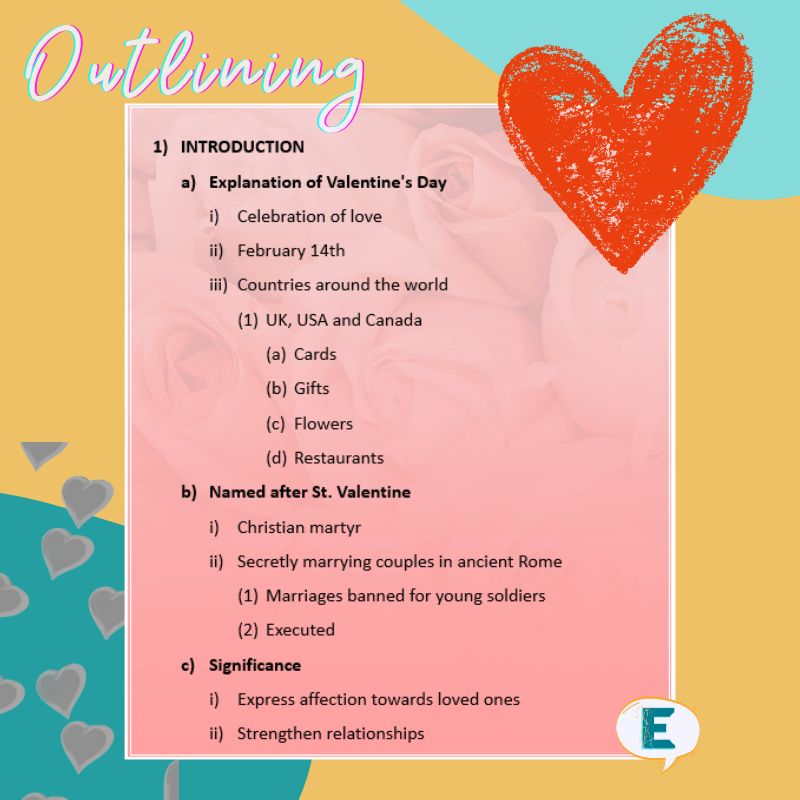
To begin your article on Valentine’s Day, create an outline that consists of several topics or sections. Examples of these topics might include “Introduction,” “Traditions and Celebrations,” and “Symbolism and Meaning.”
Within each topic, you can create sub-sections by indenting and adding more specific points. For instance, under “Introduction,” you might include sub-sections such as “Explanation of”, “Named after St. Valentine,” and “Significance”.
Within each sub-section, you can add further points to support your ideas.
The benefit of outlining as a note-taking approach is that you can easily rearrange and modify your notes by changing the level of a point or deleting and replacing it. In this example, you may wish to delete “Explanation” and replace it with “Contemporary Celebration”. This is especially easy when working with digital tools like Word or Google Docs that allow you to make rapid changes to your outlines.
Note-taking Apps (Digital)

How it Works
If you prefer to take notes on a digital device, you might want to check out popular electronic note-taking apps like Evernote and OneNote . They offer many useful features such as voice recording, image capture and search functionality. In this way, you can stay organized and on top of your notes.
In addition, you can easily sync your notes across devices and platforms. This makes it convenient to access your notes from anywhere.
In the workplace, Notion is a great option for note-taking and project management. Notion has database functionality that makes it easy to categorize and organize notes. It can even double up as a project management tool! Furthermore, collaboration features allow teams to work together on projects. And, with customizable templates, you can easily create structured notes and to-do lists.
By using these electronic note-taking apps, you can simplify your workflow, keep track of your tasks and stay on top of your projects.
Pros
They are:
- Easy to use
- Convenient and accessible
- Allow for collaboration
- Searchable
Cons
- Rely on WiFi or data plan
- Often banned from classrooms
- Require backups to protect data
Example
Let’s say you’re a medical student studying for your upcoming anatomy exam. To prepare, you decide to use a note-taking app like Evernote or OneNote to create and organize your study materials. With these apps, you can easily create and access digital notes, record lectures, and even take pictures of diagrams or models to study later.
Within the app, you can create separate notebooks or sections for each topic you need to study, such as the skeletal system, the cardiovascular system, and the nervous system. Within each notebook, you can create individual notes for each topic, including sub-points for more specific details.
For example, under the “Skeletal System” notebook, you might create a note for the “Bones of the Skull” with sub-points for each individual bone and their specific features. You can also include images or diagrams to help you study and remember the information better.
Combined Notetaking (Digital)
How it Works
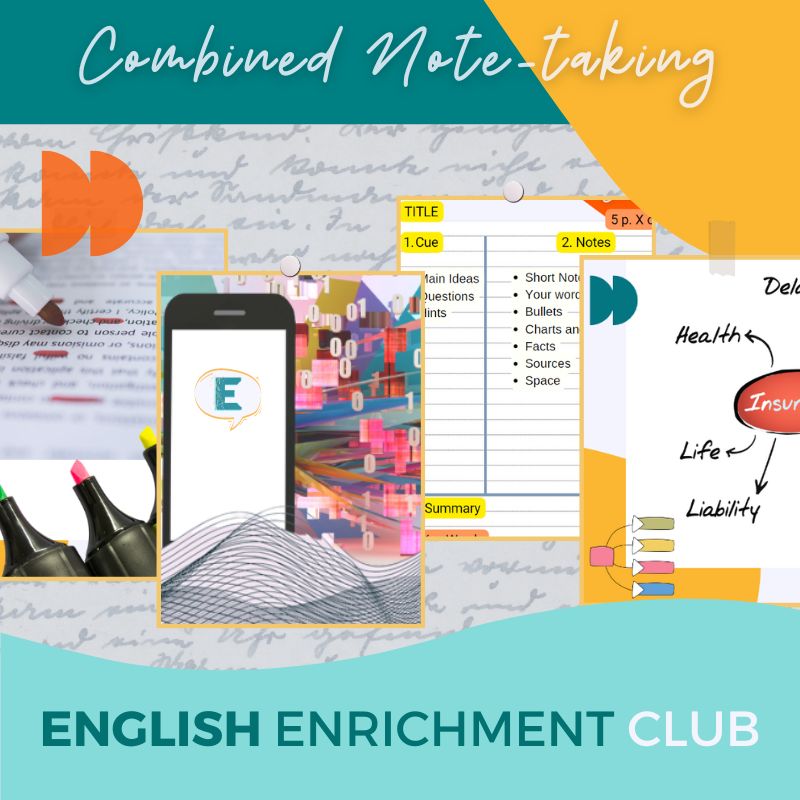
Combined note-taking is a powerful approach that can help you to organize and retain information effectively. For instance, when taking notes for a big project, you can use a combination of the Cornell system, mind maps and outlines. The Cornell system is particularly useful for breaking down complex concepts and categorizing them into smaller, more manageable parts. Mind maps can help you to visualize the connections between ideas and to brainstorm new insights. On the other hand, outlines can help you to structure your thoughts in a more linear way and to see the big picture.
In addition to these note-taking methods, you may wish to incorporate the use of highlighters, charts and voice recording. Highlighters can be used to mark key information and to make it easier to find important points later on. Charts can help to summarize data and to make it easier to compare different pieces of information. In addition, voice recording can be particularly helpful for lectures or meetings, as it allows you to capture the speaker’s words and tone of voice, which can be difficult to replicate in written notes.
By combining different note-taking methods and tools, you can create a more comprehensive and personalized system for organizing and retaining information. This can ultimately help you to better understand complex concepts and to succeed in your academic or professional pursuits.
To make sure that you can effortlessly manage all your notes and sources, it’s best to use a simple notebook, regardless of whether it’s a physical one or digital. By doing so, you can keep all your notes in one location and retrieve them easily when necessary. One approach that works well is to create an indexed notebook, with an “A to Z” section at the beginning, along with sub-indexes for topics that have a lot of content. This way, even if you have a large amount of information to organize, you can quickly find specific notes and sources without any hassle.
Pros
They are:
- Flexible
- Different methods encourage alternative ways of thinking
Cons
- Can be time-consuming
- Requires planning and organization
Example
When preparing for a job interview, combined note-taking can be a helpful strategy for staying organized and focused. To get started, you can use the Cornell system to take notes on the job description and the company’s website, allowing you to identify the key skills and values the company is looking for in a candidate.
After that, try creating a mind map to brainstorm potential interview questions and your responses. You can organize the mind map into different sections such as your qualifications, relevant experiences, and personal strengths. This approach allows you to visually see the different areas you need to prepare for.
Then, use an outline to structure your responses to each question. This way, you can stay focused and concise during the interview. During the actual interview, you can use a highlighter to mark any important information or follow-up questions you want to ask the interviewer.
Additionally, recording the interview with your phone’s voice recorder can help you review it later and improve your performance in future interviews.
Combining these note-taking methods can help you feel confident and prepared for the job interview, allowing you to communicate your qualifications effectively to the interviewer. This approach contributed to my success in getting a job offer for the position.
REVIEW , REVIEW & REVIEW
First 24 Hours
The first 24 hours after taking notes are critical to the retention of information. As Hermann Ebbinghaus, a German psychologist, found in his studies, our ability to remember information decreases rapidly over time. However, if we review our notes within the first 24 hours, we can significantly improve our retention of the information.
While it may not always be possible to conduct a thorough analysis of your notes within this time frame, it is important to at least review them and highlight the most important ideas or questions. Jotting down a few keywords can also be helpful in jogging your memory later on. This initial review can serve as a foundation for more detailed analysis and review in the future. So, be sure to set aside some time in the first 24 hours after taking notes to review and reinforce what you have learned.
Summarizing
Summarizing is an important step in retaining information from your notes. Once you have identified the most important information, try to condense it into a few key points. You can also create a mind map or diagram to visualize the information and how it relates to each other. Another helpful technique is to use different colours to highlight sub-topics and make them stand out. By summarizing your notes, you are not only improving your retention but also making the information easier to study and review later on.
Conclusion
Effective note-taking is an essential skill for students and professionals alike. By using a variety of approaches and tools, such as mind maps and notetaking apps, you can develop a system that works best for your needs. However, remember it is crucial to review/ summarize your notes within the first 24 hours and then to revise them regularly to maximize information retention.
In addition to regularly reviewing and summarizing your notes, it’s also helpful to test yourself on the material to reinforce your learning. This can include creating flashcards, practicing recall by answering questions or writing summaries from memory, and discussing the material with others. By actively engaging with the information, you’ll be better able to retain and apply it in the future.
Share your favorite note-taking strategies or ask questions in the comments below. At English Enrichment Club, note-taking is a fundamental skill that we teach, use, and encourage at all levels, from age 13+ through to adult learners. Check out our memberships where you will learn and practice a range of skills to enhance your English learning experience!