IELTS Exam Timing and Structure
If you are preparing for the IELTS exam (International English Language Testing System), you’ll know that it is a standardized test designed to evaluate the language proficiency of non-native English speakers. What’s more, this test is a benchmark for thousands of organizations worldwide including universities, immigration authorities and employers. While there are many skills you need to develop to perform well in the IELTS, time management is a critical factor for achieving a good result.
In this post, we’ll discuss IELTS time management strategies that can help you better manage your time during the exam.
First, it’s essential to understand the test’s structure and time limits. So let’s have a quick recap.
Recap of the IELTS Exam
4 Sections
The IELTS exam is divided into four sections, each testing a different language skill: Reading, Writing, Speaking and Listening. Effective time management is crucial for achieving a good result in the IELTS exam, so let’s take a closer look at each section.
Reading (3 exercises, 60 minutes)
The Reading section is designed to test your ability to understand academic passages written in English.
You will have to:
- Read three passages, and
- Answer 40 questions in 60 minutes.
- The passages are taken from books, journals, and newspapers, and cover a range of topics.
Writing (2 exercises, 60 minutes)
Moving on to the Writing section, you will have 60 minutes to complete two tasks.
- Task 1 requires you to describe, summarize, or explain visual information
- While Task 2 is an essay in response to a given topic or argument.
- It is recommended that you spend 20 minutes on Task 1 and 40 minutes on Task 2.
Speaking (3 exercises, 11-14 minutes)
For the Speaking part, you will have a one-on-one conversation with an examiner. It will be recorded. Your examiner will assesses your ability to communicate effectively in English in three different areas:
- Part 1: You will answer questions about yourself and your life.
- Part 2: You will be given two minutes to talk about a given topic.
- Part 3: You will converse with the examiner about the Part 2 topic
Listening (4 exercises, 30 minutes)
Finally, in the Listening section, you will listen to four recordings and answer 40 questions in 30 minutes.
The recordings include:
- Conversations
- Monologues, and
- Academic talks
Importantly, they are played once only! Therefore, you must take notes while you listen. By doing so, you will be able to answer the questions more effectively.
PLEASE NOTE: The exam authorities may change the format of the IELTS exam at any time. We recommend that you check the official IELTS website for the most up-to-date information on exam format and structure.
Reference Guide: Revision Exercise for IELTS Time Management Strategies
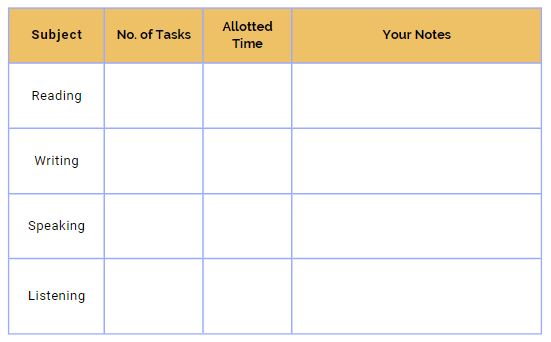
Remember, just reading about the exam format is not enough to ace it. Fill in the table below and create quick reference guide for your IELTS revision folder. Keep it at the front for a quick review anytime you need.
Effective IELTS Time Management Techniques for the Reading Section
Using a Timer to Track Your Progress
One useful technique for managing your time during the Reading section of the IELTS exam is to use a timer to track your progress. You can use a timer on your phone, watch, or computer to help you stay on track.
For example, if the Reading section is 60 minutes long and has three passages, you can set your timer for 20 minutes for each passage. This will help you manage your time and make sure you have enough time to answer all the questions.
Additionally, it’s a good idea to keep track of your word count and the time it takes you to read and answer questions for each passage. This will give you a better understanding of your pace and help you adjust your strategy if needed.
Focus on Speed-Reading
Another technique for improving your performance in this section, is to focus on speed-reading.
In short, speed-reading is a technique that involves reading quickly while still comprehending the information but not worrying about every word.
To practice, you can try reading articles or books that interest you and setting a timer for a certain amount of time. For example, try reading a news article for 5 minutes and then summarizing what you read. This will help you read faster and comprehend the information more efficiently.
Skimming and Scanning
In general, skimming and scanning are essential skills for IELTS time management.
- Skimming involves quickly reading through the text to get an idea of what it’s about.
- Scanning, on the other hand, involves searching for specific information.
To practice these skills, read articles or books with the aim of identifying:
- The main idea
- Key words, and
- Phrases.
For instance, first you can try skimming a news article. Then, re-read, and scan for specific details like names, dates, and locations.
Top Tips for IELTS Time Management in the Writing Section
Planning
Planning your response is a crucial step for effective time management in the Writing section of the IELTS exam. It not only helps you organize your thoughts but also ensures that you stay on topic throughout the task.
By taking some time to plan, you can also focus on the organization of your ideas and structure your response in a way that is easy to follow for the reader.
As the famous writer, Stephen King, once said,
“The scariest moment is always just before you start. After that, things can only get better.”
So, don’t be scared of planning – it can only improve the quality of your writing and make the task easier for you.
Time Allocation
During the IELTS Writing section, managing your time effectively is crucial to completing both tasks within the allotted time frame.
One way to do this is by allocating time for different stages of the writing process.
For example:
- First, you can set aside the first 5 minutes to plan and organize your response.
- Next, use the next 12-13 minutes to write your answer, ensuring that you focus on content and structure.
- Finally, use the last 2-3 minutes to check for errors, including spelling, grammar, and punctuation.
You can use a timer on your phone or computer to track your progress and make sure you stick to your time limits.
Remember, practice makes perfect, and with enough practice, you can become comfortable with managing your time effectively and achieving exam success.
Typing Skills
As more and more students are taking the computer-delivered version of the IELTS exam, typing skills are becoming increasingly important for the Writing section.
To improve your typing speed and accuracy, you can practice using a computer typing program like Typing.com or by typing out sample essays.
It’s also a good idea to practice typing under time pressure to simulate the time limit of the exam.
For instance, you can try typing out an essay in 40 minutes to help you get used to the pace of Task 2.
With regular practice, you can improve your typing skills and feel confident when taking the computer-delivered IELTS exam
Mastering IELTS Time Management for the Speaking Section
Preparing for the IELTS exam can be overwhelming, especially when it comes to the Speaking section. Questions in Parts 1 and 3 are asked by the examiner and it is essential to use the approximately 10 minutes you have to give full but concise answers.
Responses with many pauses, filler words or one-word answers can negatively impact your score.
However, timing is dictated by the examiner, so in the remainder of this section, we will focus on pre-IELTS time management strategies that can help you prepare for the Speaking tasks.
Record Yourself
Recording yourself while practicing speaking is a helpful technique for improving your Speaking section performance and can help you make the most of your practice time.
It is especially useful for Part 2 – where you have a 2 min topic. Pay attention to the length of your introductions and conclusions so that they are not too long. By reviewing your recordings, you can identify areas for improvement and focus your practice sessions accordingly.
Perhaps, there are phrases that are causing you difficulty. Look for alternatives. This way, you can make the most of your practice time and ensure that you are making progress towards your goals.
Working With a Partner
With advancements in technology, finding a partner to practice with for the IELTS exam has become easier.
Various websites and forums, such as conversationexchange.com, provide platforms for students to connect with others who are preparing for the exam.
Practicing with a partner has numerous benefits for building your speaking confidence. In terms of IELTS time management, it helps you learn to both ask and answer questions in real-time. When you have to set the questions as well as answer them, it gives you a different perspective on “how” and “how long” the answers should be. This feedback you give to your partner can also help you clarify what you need to do to increase fluency in a conversational situation.
Preparing Random Topics
Another way to enhance your time management skills for the IELTS Speaking section is to practice with random topics.
Create a list of common IELTS topics and randomly select one for which to prepare a one-minute speech.
This will help you develop the ability to think on your feet and express your ideas quickly and coherently. Being able to do this is a valuable skill for managing your time during the Speaking section.
Even if the topics you practice don’t come up in the actual exam, this exercise is still beneficial in terms of quickly gathering your thoughts and speaking about a topic.
It is also an excellent exercise to practice with a partner.
Maximizing Your IELTS Time Management Skills for the Listening Section
When it comes to time management and listening skills in the IELTS exam, it is important to focus on staying present and using your time effectively.
Real-time Focus
One strategy is to actively listen to the recording and focus on understanding the main ideas and details, rather than getting stuck on specific words or phrases you may not understand. This allows you to use your time efficiently and answer as many questions as possible within the given time limit.
Note-Taking
Additionally, note-taking can be a useful technique for both active listening and time management. By summarizing the information you hear, you can quickly refer back to it when answering questions and avoid wasting time trying to recall details.
Time Tracking
Finally, using a timer to track your progress while practicing can help you become more aware of how much time you have for each task, and how to effectively use that time to answer the questions
Your Thoughts? IELTS Time Management INFOGRAM
How did you find our article on IELTS time management strategies?
To make things even easier for you, we have prepared an infogram summarizing the key points for each section of the exam. By improving your time management skills in the reading, writing, speaking, and listening sections, you can boost your IELTS score and prepare for success in higher education or the workplace.
Remember, these skills are not only important for IELTS but for many aspects of using English in your life. If you want to develop your skills further and gain access to practical working examples and a supportive community, check out our FREE Facebook Group and EEC membership program.
Skills for Life
Remember, these skills are not only important for IELTS but for many aspects of using English in your life.
If you want to develop your skills further and gain access to practical working examples and a supportive community, check out our FREE Facebook Group and EEC membership program.